Outcomes · PROMs & PREMs

Did the treatment actually work?

A signature captures a moment. Outcomes capture the result. GetConsent sends validated questionnaires at baseline and at scheduled follow-ups, scores each one correctly, and tracks change against the patient’s own baseline, including whether it crosses the instrument’s minimal clinically important difference. Not a survey tool. A clinical outcomes registry.
app.getconsent.health/admin/proms-dashboard
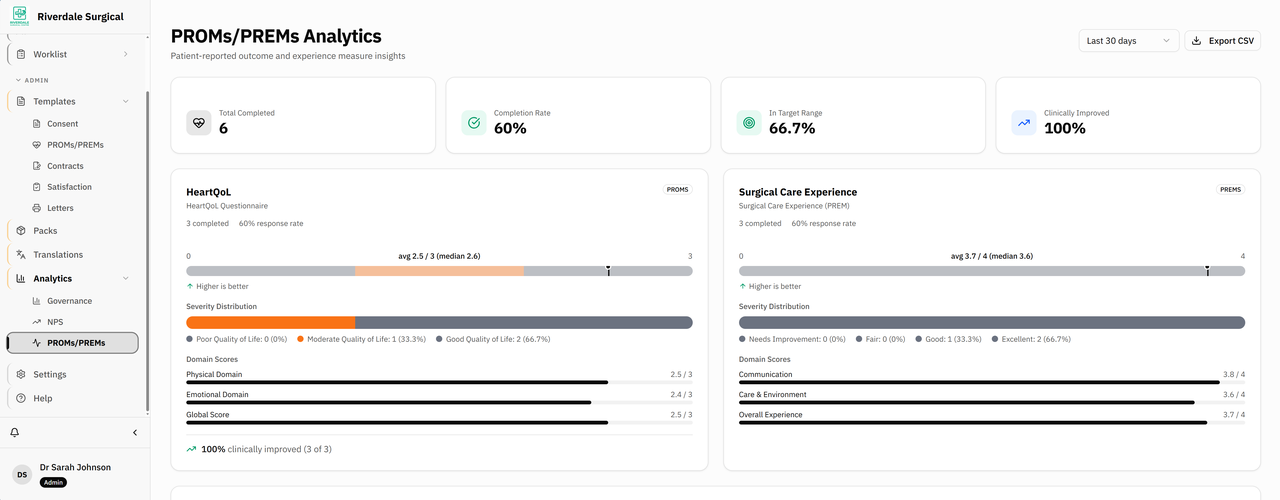
GetConsent PROMs and PREMs analytics dashboard showing completion, severity distribution, change-from-baseline, and per-instrument outcomes

The outcomes dashboard: completion, severity distribution, and mean change against the MCID, across every instrument in use.

The instrument library

~59 validated instruments, ready on day one

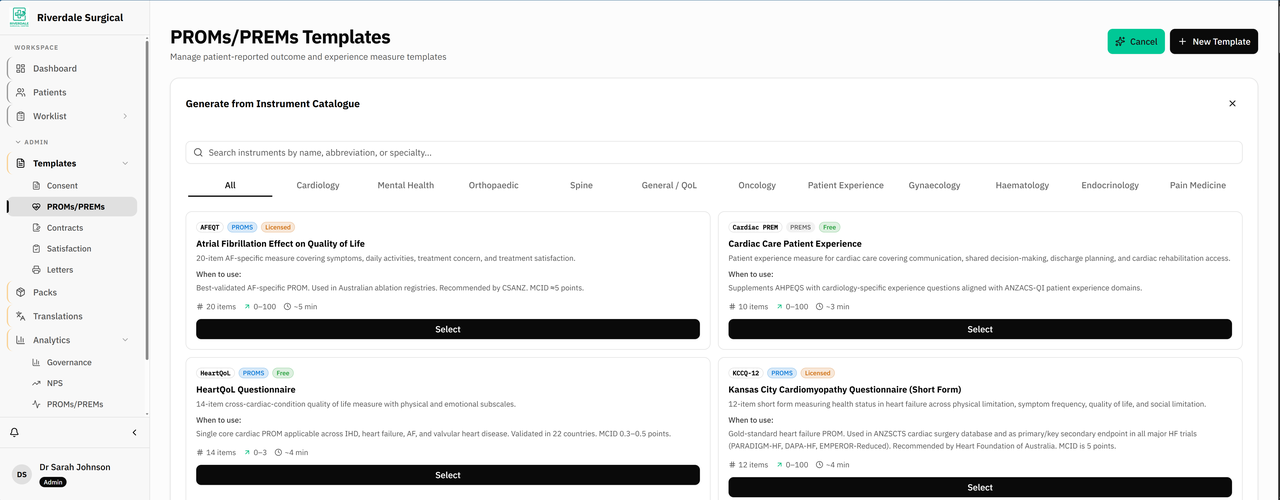
Each carries its real provenance, citation, scoring configuration, score range, and licence status, across 11 specialties. Browse by specialty, or let the licence-aware AI generator draft new ones.
Mental health
PHQ-9GAD-7K10DASS-21PCL-5
Orthopaedic
Oxford Hip (OHS)Oxford Knee (OKS)KOOSHOOSWOMACDASH
Spine
Neck Disability IndexOswestry (ODI)
Cardiology
KCCQ-12SAQ-7AFEQTHeartQoL
General & quality of life
EQ-5D-5LSF-36WHODAS 2.0PROMIS-10
Oncology
EORTC QLQ-C30
app.getconsent.health/admin/proms-instruments
GetConsent instrument library showing 58 validated PROM and PREM instruments by specialty, with score ranges, licence status, and MCID
Measure over time, not at a moment

From baseline to follow-up, automatically
app.getconsent.health/patient/proms
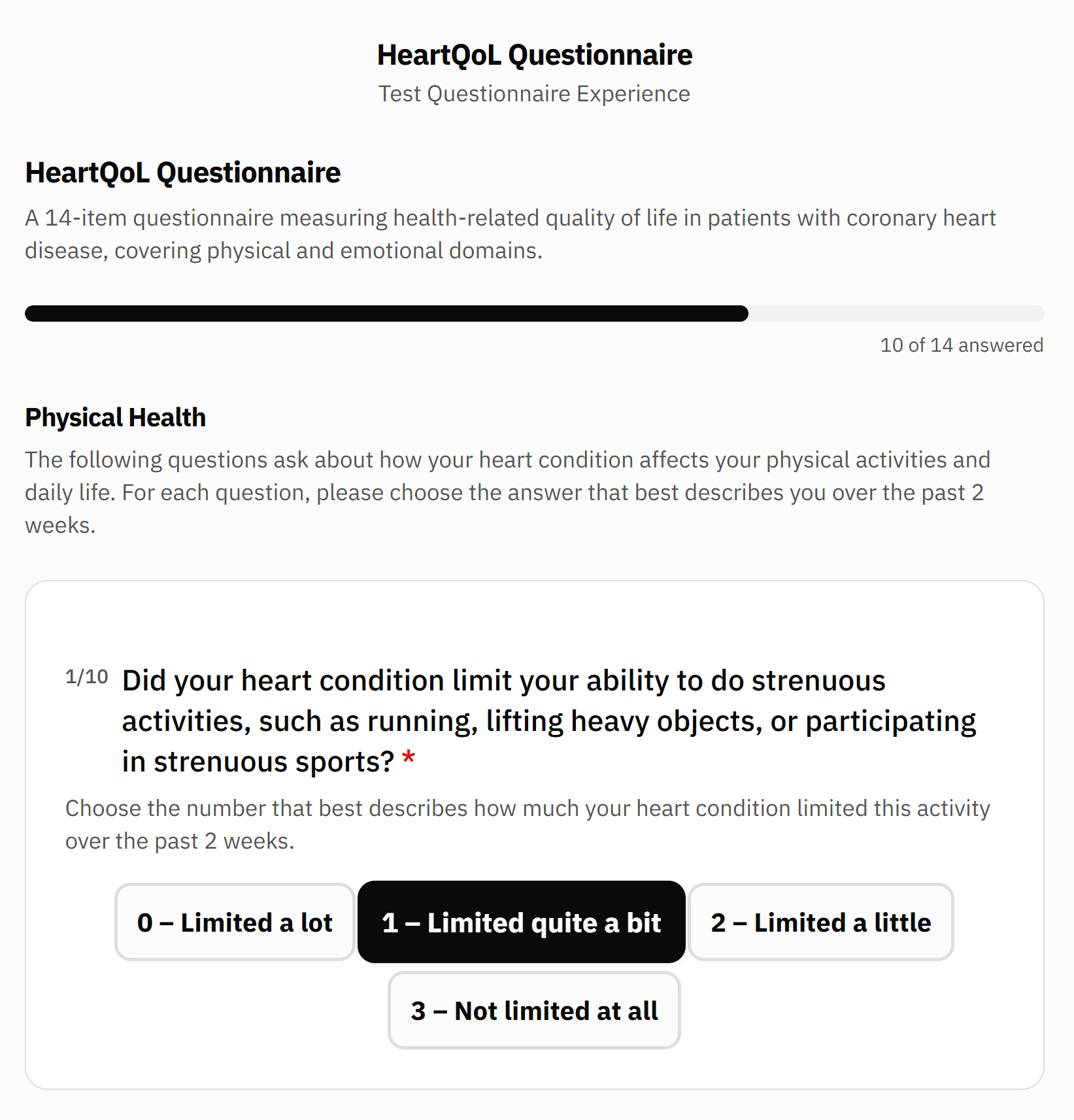
GetConsent patient PROMs questionnaire (HeartQoL) showing a plain-language question with a progress bar, completed on the patient's own device
Collection plans
Create a baseline plus its follow-ups (6 weeks, 3 months, 12 months) in one step. Follow-ups send themselves on schedule, no chasing.
Instrument-correct scoring
Five scoring algorithms with reverse scoring, weighted multi-domain subscales, missing-data rules, and severity bands, applied exactly as each instrument requires.
Change against the MCID
On each follow-up, the score is compared to the patient’s own baseline and classified improved, unchanged, or worsened against the published minimal clinically important difference.
Severity & domain breakdown
Per-patient total score, domain subscales, and severity band, cached for fast analytics and surfaced to the clinician before the next visit.
Analytics dashboard
Completion rates, response trends, per-template severity distribution, domain averages, and MCID metadata across the service.
FHIR-native
Templates serialise as FHIR Questionnaire and responses as QuestionnaireResponse, so outcome data flows to your EMR in standard format.
The value-based-care story

Prove your care works

Consent is a compliance purchase. Outcomes are the value purchase. For orthopaedics, mental health, cardiology, oncology, and pain medicine, PROMs are how you join a registry, satisfy value-based-care reporting, and show accreditation evidence (such as NSQHS partnering-with-consumers) supported with data, not anecdote.

See it for your specialty →
What you can finally say

“Six weeks after surgery, this patient’s Oxford Knee Score improved by 18 points, well past the clinically important threshold. And I can show that across every patient I operate on.”

  Measure what matters  

Turn outcomes into evidence

Clinics & practices

Send a real consent today

Solo clinicians and small practices set up in an afternoon and send their first consent the same day. No procurement, no sales call, no card. Nothing about your current process has to change until you are satisfied.

Hospitals & networks

See it run on your workflow

Multi-site hospitals and networks get a 30-minute demo configured for your EMR, your SSO, and the governance reports your accreditors actually ask for. You leave with a working trial account.