AI-generated consent templates: where the AI stops and the clinician starts
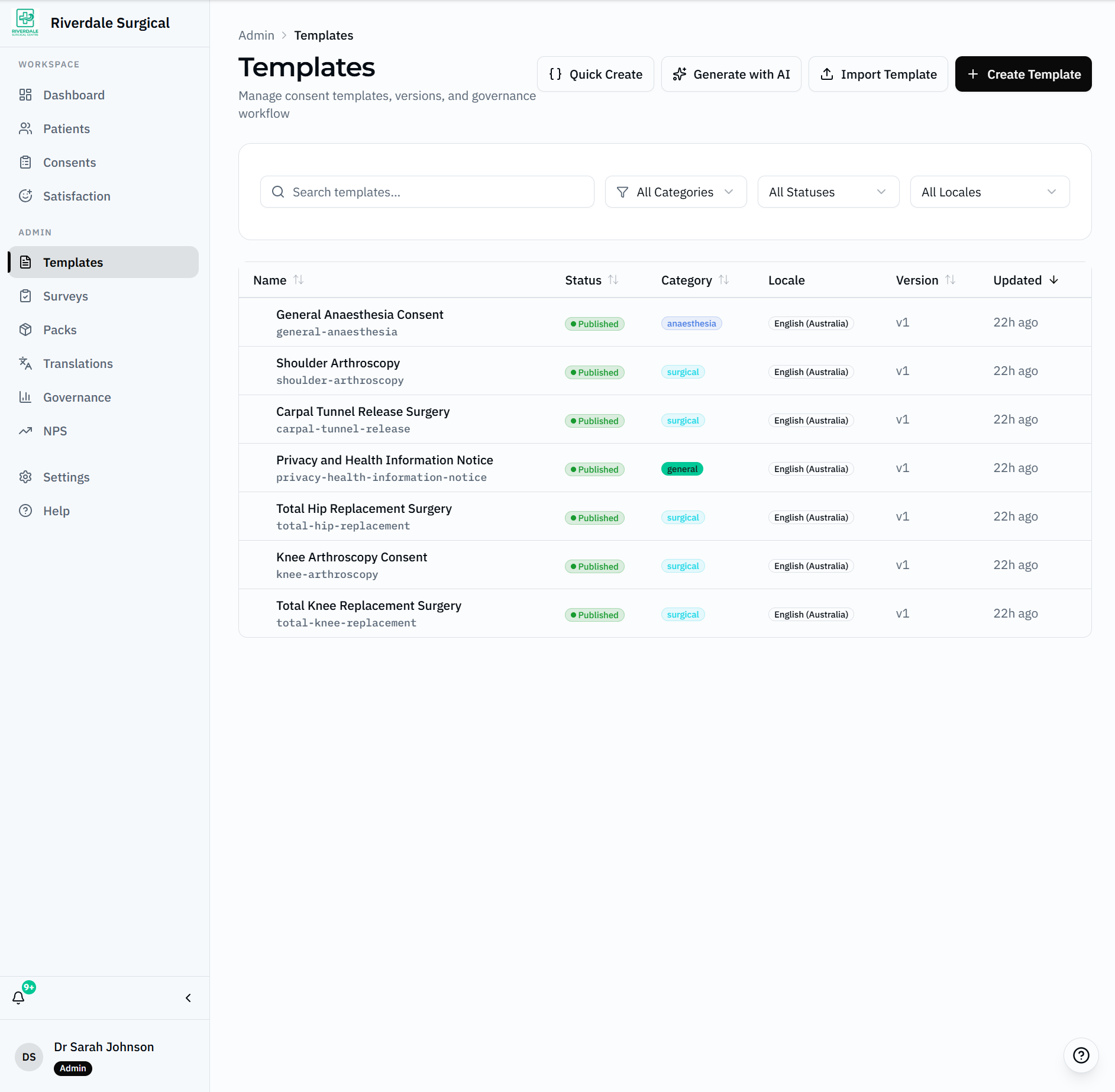
AI is transforming healthcare documentation, and consent templates are no exception. Large language models can draft patient-friendly explanations of surgical procedures, generate risk descriptions calibrated to evidence-based incidence rates, and translate clinical content into multiple languages with remarkable fluency.
At GetConsent, we use AI extensively in the template creation process. But we draw a hard line between AI-assisted drafting and AI-autonomous publishing. The distinction matters because the consequences of an inaccurate consent template are not abstract. They are clinical, legal, and deeply personal to the patient whose decision depends on that information.
What AI does well in consent template creation
AI excels at several tasks in the consent template workflow. It can generate a first draft of patient-facing content from clinical procedure descriptions, translating medical terminology into plain language. It can produce translations in multiple languages that capture clinical meaning, not just literal word substitution. It can suggest comprehension questions that test understanding of key concepts rather than recall of specific phrases.
These capabilities dramatically reduce the time required to create a new consent template. What previously took days of drafting, review, and translation can now produce a first draft in minutes. But a first draft is not a published template.
The four-stage governance workflow
Every consent template in GetConsent passes through four stages before it reaches a patient: Draft, Clinical Review, Approval, and Publication.
In the Draft stage, AI generates initial content based on the procedure type, clinical inputs, and the organisation’s style and language requirements. The output is a starting point, not a finished product.
In Clinical Review, a clinician with relevant procedural expertise reviews the AI-generated content for clinical accuracy, completeness, and appropriateness. They verify that the risks described match current evidence, that the alternatives presented are genuinely available, and that the language is appropriate for the target patient population.
In Approval, a designated clinical governance owner (typically a department head or clinical director) formally approves the template for use. This approval is recorded with the approver’s identity and timestamp.
Only after all three preceding stages are complete can a template move to Publication, where it becomes available for use in patient consent sessions. The entire history of drafts, reviews, and approvals is retained as part of the template’s version record.
Why the distinction matters
The distinction between AI drafting and human governance is not a philosophical position. It is a practical response to the current limitations of AI in clinical contexts.
Language models can produce fluent, plausible clinical text that is factually incorrect. They can understate rare but serious risks, overstate the certainty of outcomes, or omit alternatives that are relevant to a specific patient population. These errors are difficult to detect because the output reads convincingly.
In a consent context, an inaccurate template does not just create a documentation problem. It creates a clinical problem. A patient who makes a decision based on incomplete or incorrect information has not given informed consent, regardless of what they signed.
Human clinical review is not a bottleneck in this workflow. It is the quality gate that ensures AI efficiency does not come at the cost of clinical accuracy.
Translation: the same principle applies
AI-generated translations follow the same governance model. The AI produces a first-pass translation. A human reviewer with clinical domain expertise and native-level language proficiency reviews and corrects the translation. Only the reviewed translation is published.
This approach balances the scale advantages of AI translation with the accuracy requirements of clinical consent. A patient reading a consent form in Vietnamese or Arabic is entitled to the same clinical accuracy as a patient reading it in English. AI makes this feasible at scale. Human review makes it reliable.
See GetConsent in action
Book a 30-minute demo configured for your specialty and workflow.
Request a demo